Medical cable overmolding improves strain relief, connector protection, and interface durability in medical cable assemblies. This guide explores material selection, overmold geometry, sealing design, manufacturing processes, and verification methods to help engineers evaluate reliable overmolded cable solutions for medical devices.
Medical cable overmolding is used to create a molded protective section around a cable-to-connector interface. It can improve strain relief, support connector handling, and help protect exposed transitions from mechanical or environmental stress.
For medical device manufacturers, the main design challenge is balancing flexibility, material compatibility, sealing requirements, and long-term durability. The finished assembly must also remain suitable for its intended cleaning, disinfection, and sterilization conditions where applicable.
Why Is Overmolding Important for Medical Cable Assemblies?
The connector-to-cable transition is exposed to repeated bending, pulling, and handling. Without suitable mechanical support, stress can concentrate near the termination and contribute to conductor fatigue or jacket damage.
A properly designed overmold can distribute mechanical loads across the transition and provide a more controlled cable exit.
Common design objectives include:
-
Strain relief: Reducing concentrated bending stress near connector terminations.
-
Mechanical protection: Covering exposed solder joints, crimp connections, and cable transitions.
-
Handling comfort: Creating a grip surface and consistent external profile.
-
Environmental protection: Supporting a sealing design when the complete interface is properly engineered and verified.
Overmolding does not automatically make a medical cable waterproof or suitable for sterilization. These properties depend on the materials, interface design, manufacturing process, and validation results.
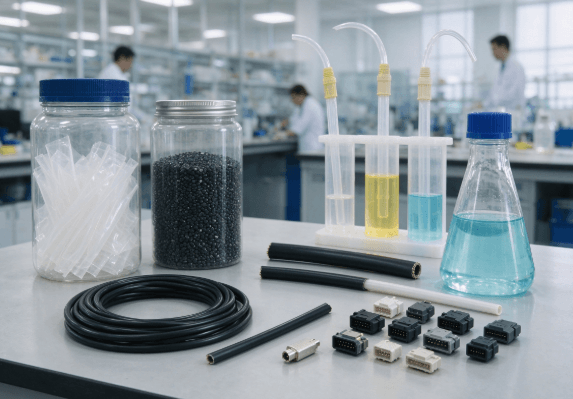
Which Materials Are Suitable for Medical Cable Overmolding?
Material selection depends on the required flexibility, hardness, adhesion, temperature range, and exposure to cleaning chemicals.
Common material options include TPU, TPE, silicone, and selected engineering polymers. Their performance varies by formulation and supplier grade.
| Material |
Relevant characteristics |
Design considerations |
| TPU |
Abrasion resistance, flexibility, and mechanical strength |
Check compatibility with cable jackets and cleaning agents |
| TPE |
Flexible processing options and different hardness grades |
Confirm bonding performance and chemical resistance |
| Silicone |
Soft feel and flexibility across a broad temperature range |
Evaluate tear resistance, adhesion, and molding requirements |
| Engineering polymers |
Higher structural rigidity and dimensional stability in selected applications |
May be unsuitable where a soft, flexible transition is required |
There is no universally suitable medical overmolding material. The selected grade should be evaluated against the actual operating environment.
For example, reusable equipment may require repeated exposure to disinfectants. Portable devices may prioritize a softer grip and resistance to repeated bending.
Material compatibility also involves the cable jacket and connector housing. A material that performs well independently may not bond reliably with the selected substrate.
For a broader comparison of insulation and jacket materials, see SOAR's medical cable assembly materials guide.
How Do Overmold Geometry and Sealing Affect Cable Reliability?
The shape of the molded section influences how mechanical loads transfer between the connector and cable.
An abrupt stiffness transition can concentrate bending stress near the end of the overmold. A gradual transition may distribute bending more evenly, depending on the cable construction and movement profile.
Important design inputs include:
-
Cable outside diameter and jacket thickness.
-
Connector housing dimensions and available molding space.
-
Overmold length, wall thickness, and exit angle.
-
Required flexibility and strain-relief performance.
-
Grip texture and handling requirements.
-
Clearance around the device enclosure and adjacent connectors.
Sealing requires additional attention. The interface between the connector, cable jacket, and molded material can create potential leakage paths.
A successful sealing design depends on material compatibility, surface preparation, molding conditions, interface geometry, and process consistency.
If an ingress protection rating is required, the complete finished assembly should be tested against the specified requirement. A molded exterior alone does not establish an IP rating.
What Should Manufacturers Control During the Overmolding Process?
Overmolding quality depends on more than selecting the correct resin. Insert positioning, material preparation, tooling condition, and molding parameters can all influence the finished assembly.
A typical manufacturing sequence includes:
-
Cable preparation: Cut, strip, and prepare the cable according to the approved drawing.
-
Connector termination: Complete crimping or soldering and verify the required electrical connections.
-
Insert positioning: Place the terminated assembly accurately in the molding fixture.
-
Material molding: Apply the specified polymer under controlled processing conditions.
-
Cooling and demolding: Allow the molded section to stabilize before removing the assembly.
-
Final inspection: Check dimensions, appearance, interface integrity, and specified electrical characteristics.
Process parameters may include material drying, melt temperature, injection pressure, holding time, and cooling conditions, depending on the selected material and tooling.
Common defects include incomplete filling, flash, surface damage, voids, poor bonding, and dimensional variation.
Changes to resin grade, cable jacket, connector supplier, or mold design may affect the process window. These changes should be reviewed before production continues.
SOAR's workshop overview shows its listed production operations, including wire preparation, terminal processing, soldering/overmolding, assembly, and packing.
How Should an Overmolded Medical Cable Be Evaluated?
Verification should focus on the actual failure risks identified during product design.
A practical evaluation plan may include:
| Inspection or test |
What it evaluates |
| Visual inspection |
Surface defects, flash, incomplete filling, and appearance |
| Dimensional inspection |
Overmold length, diameter, and interface geometry |
| Pull testing |
Mechanical retention of the cable and connector transition |
| Flex testing |
Resistance to repeated bending at the cable exit |
| Adhesion assessment |
Bonding between the overmold and underlying materials |
| Leakage testing |
Sealing performance against a defined requirement |
| Chemical exposure testing |
Material compatibility with specified cleaning agents |
| Electrical verification |
Continuity and other specified electrical characteristics |
Not every assembly requires every test. The verification plan should reflect its intended use, risk assessment, and applicable device requirements.
For reusable medical equipment, repeated cleaning and disinfection may affect surface condition, material hardness, and interface integrity.
Sterilization testing is necessary only when the intended use requires it. Autoclave, EtO, and radiation processes can affect polymer materials differently, so compatibility must be established for the finished assembly.
For more information about electrical and mechanical verification, refer to SOAR's medical cable assembly testing and quality requirements guide.

What Information Should Be Included in a Medical Cable Overmolding RFQ?
A clear technical specification helps manufacturers evaluate tooling, material compatibility, and production feasibility.
An RFQ package should include:
-
Connector part numbers, drawings, and housing dimensions.
-
Cable construction, outside diameter, and jacket material.
-
Proposed overmold material or required performance characteristics.
-
Overmold dimensions, hardness, shape, and cable exit direction.
-
Required sealing or ingress protection performance.
-
Cleaning agents and sterilization conditions, where applicable.
-
Expected bending, pulling, and handling conditions.
-
Inspection methods and acceptance criteria.
If the final material or geometry has not been selected, identify these as open design items rather than assuming compatibility.
Prototype samples can then be reviewed for fit, handling, bonding, and mechanical performance before the design is released for production.
SOAR Medical Cable Assembly Resources
SOAR's Medical Cables collection provides an overview of its medical cable product category.
Its workshop also lists soldering and overmolding among its manufacturing operations.
For a specific medical cable project, material grade, connector interface, overmold geometry, sealing performance, and applicable testing should be confirmed against the approved technical requirements.
FAQ
Does medical cable overmolding make a cable waterproof?
Not automatically. Water resistance depends on the complete connector interface, cable transition, material bonding, and verified sealing performance.
What is the difference between overmolding and strain relief?
Overmolding is a manufacturing process that forms polymer material around an assembly. Strain relief is a mechanical design function that reduces stress near cable connections. An overmold can provide strain relief when properly designed.
Which material is commonly used for medical cable overmolding?
TPU, TPE, and silicone are possible options. The appropriate material depends on flexibility, chemical exposure, adhesion, temperature, and intended use.
Can overmolded medical cables withstand repeated sterilization?
Only when the complete assembly has been evaluated for the specified sterilization method and exposure cycles. Material suitability should not be assumed from the polymer name alone.
Why does overmold geometry affect cable life?
The geometry influences how bending forces transfer between the connector and cable. Poor transitions can create localized stress and contribute to premature damage.
Reference Sources
-
FDA – Quality and Compliance: Medical Devices
-
ISO 13485:2016 – Medical Devices Quality Management Systems
-
IEC 60601-1 – Medical Electrical Equipment