

2026-10-22
The evolution of automotive architecture from simple mechanical systems to high-speed data networks has necessitated a specialized class of interconnects. At the heart of this transition is the FAKRA (Fachkreis Automobil) connector. Originally derived from the SMB (SubMiniature version B) interface, FAKRA connectors have become the global standard for RF (Radio Frequency) signals within the automotive ecosystem.
As vehicles integrate more sensors, high-definition cameras, and satellite navigation, the demand for stable, vibration-resistant, and error-proof connectivity has surged. Understanding FAKRA connector applications requires a deep dive into how these components maintain signal integrity in the harsh electrical and physical environments of a moving vehicle.
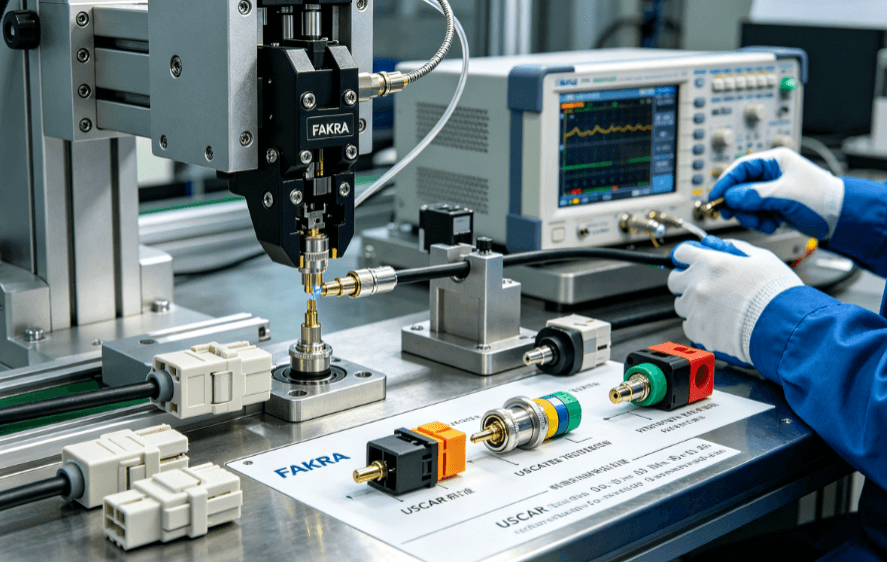
FAKRA connectors are high-performance RF connectors designed specifically for the automotive industry. They consist of a standard SMB coaxial insert housed within a specialized plastic locking shroud. This design provides two critical benefits: mechanical robustness and visual identification.
The plastic housing features a primary locking mechanism that prevents disconnection due to shock or vibration—common challenges in automotive environments. Furthermore, FAKRA connectors utilize a color-coding system (Standardized by ISO 20860-1) and mechanical keying to prevent "mismatching" during assembly, which is essential on complex production lines where dozens of similar cables are routed simultaneously.
Global Positioning Systems (GPS) and Global Navigation Satellite Systems (GNSS) are perhaps the most ubiquitous FAKRA connector applications. Precise positioning relies on receiving extremely weak signals from satellites orbiting thousands of miles away.
In a GPS circuit, the FAKRA Code C (Signal Blue) connector is typically used. Engineers prioritize FAKRA for GPS for several reasons:
As vehicles move toward higher levels of autonomy, Advanced Driver Assistance Systems (ADAS) have become mission-critical. These systems rely on a suite of cameras—rearview, 360-degree surround-view, and forward-facing sensing cameras—to interpret the vehicle's surroundings.
Unlike traditional analog video, modern automotive cameras utilize digital high-speed links like GMSL (Gigabit Multimedia Serial Link) or FPD-Link. These protocols require connectors that can handle data rates up to 6 Gbps or higher. FAKRA connectors, particularly the newer "High-Speed FAKRA" or FAKRA-SF (Small Form factor) variants, are designed to support these bandwidth requirements while maintaining a compact footprint.
Cameras are often mounted externally, exposed to moisture, salt spray, and extreme temperatures. FAKRA connectors used in these applications are frequently rated to IP67 or IP69K standards. The mechanical "click" of the locking system ensures that the connection remains secure even when the vehicle hits a pothole or travels at high speeds.
The "Connected Car" concept relies on telematics units that communicate with cellular networks (4G LTE/5G), Wi-Fi, and other vehicles (V2X). This multi-frequency communication environment utilizes various FAKRA color codes to segregate signals:
| Color Code | Standard Application | Typical Usage |
|---|---|---|
| Code A (Black) | AM/FM Radio | Standard terrestrial radio reception |
| Code C (Blue) | GPS / Telematics | Satellite navigation and timing |
| Code D (Violet) | Cellular / GSM | 4G/5G mobile data connectivity |
| Code E (Green) | TV / Video | On-board entertainment and digital video |
| Code I (Beige) | Bluetooth / Wi-Fi | Short-range wireless communication |
| Code Z (Water Blue) | Neutral / Universal | Diagnostic and general-purpose RF |
By using different mechanical keys for each color, manufacturers eliminate the risk of a technician accidentally plugging a cellular antenna into a GPS port.
When evaluating FAKRA connectors for automotive design, engineers focus on specific performance metrics that distinguish them from standard industrial RF connectors.
FAKRA connector applications are heavily dependent on the quality of the cable they are terminated to. Most automotive applications utilize thin, flexible coaxial cables like RG-174, which offer a balance between signal performance and bend radius. For applications requiring lower attenuation over longer distances—such as routing a signal from a shark-fin antenna at the rear of an SUV to the front dash—engineers may opt for higher-spec cables with improved dielectric materials.
As we look toward the future, the FAKRA standard continues to evolve. The industry is seeing a shift toward "Mini-FAKRA" (also known as HFM - High-Speed FAKRA-Mini). These connectors offer a 400% space saving compared to traditional FAKRA while supporting frequencies up to 20 GHz. This evolution is essential for the next generation of 5G-integrated vehicles and high-resolution LiDAR systems that demand unprecedented data throughput.


